ESSAY
The Myth of
Productivity
Why burnout is not a time management problem.
From Bloom & Vine
Series On Coherence
Reading time 9 min
Few ideas dominate modern work as thoroughly as productivity. Books promise it. Apps promise it. Courses promise it. We are told that with the right system, the right calendar structure, or the right morning routine, we can finally become the kind of people who accomplish everything we intend.
Productivity culture begins with a straightforward assumption: the central problem of modern work is that people are not efficient enough. If we could only organize our time better, manage our tasks more carefully, and eliminate distraction, the good life — meaningful, purposeful, sustainable — would follow.
But if we look honestly at the lives of many thoughtful and capable people, a different picture emerges. The problem is rarely laziness. Many people are already working at a remarkable pace. Their schedules are full. Their days are structured. Their efforts are sincere. And yet many of them still experience a persistent form of exhaustion — not the tiredness that comes from physical effort, but the fatigue that comes from moving constantly without a clear sense of where they are going
When Efficiency Becomes the Wrong Question
Productivity systems tend to ask one primary question: how can we get more done? This assumes that the central challenge of work is execution — that if people could simply do more, faster, with fewer interruptions, the problem would resolve itself.
But execution is only meaningful when it serves a coherent purpose. If our priorities are unclear, becoming more efficient can actually deepen the problem. It allows us to move faster in directions we have not carefully chosen.
Productivity culture sometimes resembles a treadmill. The speed increases. The effort increases. But the sense of genuine progress does not necessarily increase with it.
Many people discover, after years of refining their systems, that they have become highly efficient at tasks that do not ultimately feel meaningful. The output is impressive. The sense of direction remains elusive.
The Deeper Problem Beneath Burnout
When people describe burnout, they often emphasize long hours or overwhelming workloads. Those are real. But they do not tell the whole story. Some of the most exhausting experiences of work occur not when there is too much to do, but when there is a fundamental mismatch between the different parts of a person's life.
A person may hold strong personal convictions but find little space to express them in their work. A person may care deeply about family life but feel that professional demands consistently crowd it out. A person may pursue creative or intellectual work while navigating an environment that rewards only speed and measurable output. In each of these situations, the problem is not simply the number of tasks. It is misalignment — the different elements of life pulling in different directions until the tension becomes quietly unsustainable.
Identity moves one way. Work moves another. Habits drift somewhere else entirely. Over time, sustaining that tension costs more than any productivity system can compensate for.
Productivity Without Coherence
Modern productivity tools — calendars, task managers, time-blocking methods — can certainly be useful. But they operate at the surface level of work. They help organize activity. They do not clarify purpose.
Without a deeper framework, productivity tools can become another form of pressure. People feel obligated to optimize every hour. They track tasks carefully but rarely step back to ask the more fundamental question: is the structure of my life actually aligned with what matters most to me?
When that question remains unexamined, productivity becomes a mechanism for sustaining fragmentation more efficiently — doing more of what already feels hollow, faster.
A Different Question
What if the central challenge of modern work is not productivity at all? What if the real challenge is alignment?
Alignment begins with a different set of questions. Not how do I get more done, but who am I becoming? Not how do I optimize my calendar, but what kind of work deserves my deepest attention? Not how do I eliminate distraction, but what environments support clarity rather than scatter it?
These questions move beyond efficiency. They address coherence — the relationship between identity, purpose, habits, and the environment in which daily life unfolds.
The Four Elements of Alignment
A coherent working life tends to rest on four interconnected elements. When these elements support one another, work becomes sustainable. When they pull in different directions, no productivity system can fully compensate.
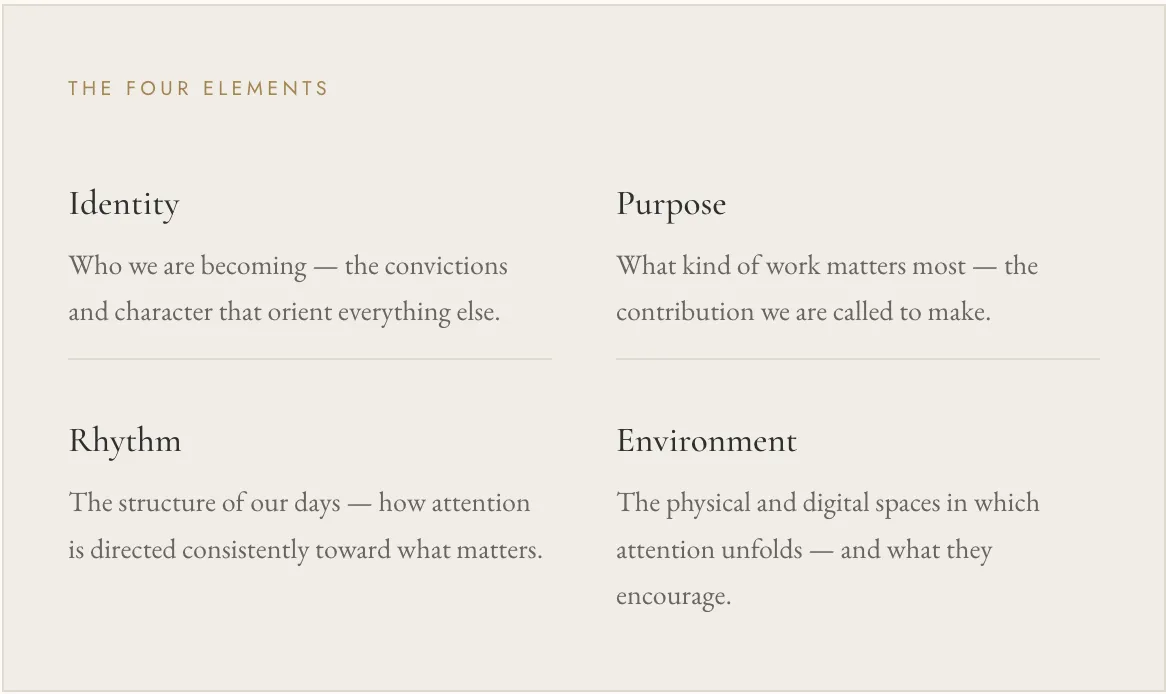
When these four elements are aligned, productivity often follows naturally — not as the primary goal, but as a consequence of working from a coherent center. When they are misaligned, even sophisticated productivity systems will struggle to produce the deeper sense of satisfaction that most people are really after.
The Difference Between Motion and Meaning
One of the dangers of productivity culture is that it blurs the distinction between motion and meaning. A person can move quickly through an impressive number of tasks and still feel disconnected from the deeper direction of their life.
Motion is visible and measurable. Meaning is not always immediately visible. But meaning is what sustains effort over time. It provides the narrative that explains why certain kinds of work matter — why the effort is worth making, and what it is building toward. Without that narrative, even genuinely successful work can feel strangely hollow.
Reclaiming Meaningful Work
Reclaiming meaningful work requires something productivity culture rarely encourages: periods of genuine reflection. Moments when we step back from the relentless pressure to produce and examine the shape of our lives rather than just the efficiency of our systems.
These moments allow us to ask whether the different parts of life — faith, family, work, and personal formation — are moving in the same direction. When they are not, productivity improvements alone will rarely solve the problem. What is needed is realignment: small, deliberate adjustments in priorities, habits, and environments that gradually restore coherence.
The answer to burnout is rarely a more sophisticated productivity system. It is a more coherent life.
Beyond Productivity
The goal of work is not merely output. It is participation in a meaningful life — one in which what we do reflects who we are and what we actually believe matters. Productivity can support that goal. But productivity alone cannot define it or create it.
When alignment is restored, work tends to become both more effective and more humane. Energy is directed toward what truly matters. Habits support purpose rather than compete with it. The pace of work becomes sustainable rather than frantic, because effort is no longer being spent managing the friction of misalignment.
This shift — from productivity as the primary framework to alignment as the deeper one — does not eliminate the need for discipline or structure. Good habits still matter. Careful attention to time still matters. But these tools take their proper place as instruments that support a coherent life, rather than substitutes for one.
And when work begins to flow from coherence rather than fragmentation, something unexpected often happens. Productivity improves. But more importantly — meaning returns.
Series
The Fragmentation of Modern Life
→ The Myth of Productivity
Creativity as Vocation
Motherhood as Cultural Architecture
Attention and the Architecture of a Day
Bloom & Vine
These essays arrive weekly in the newsletter — alongside reflections on faith, family life, and meaningful work.
Previous Essay
Next Essay
Continue Reading
Essays and reflections on time, vocation, and meaningful living.
Join Bloom & Vine to receive new essays as they are published — weekly, without noise.
Monica Anyango
Totum Peak is the platform connecting Monica Anyango’s writing, formation work, and cultural projects. © 2026